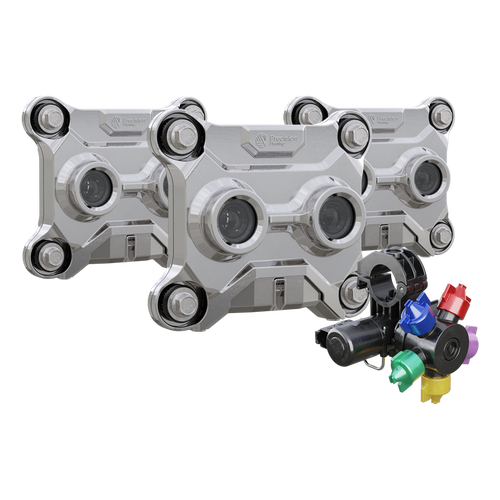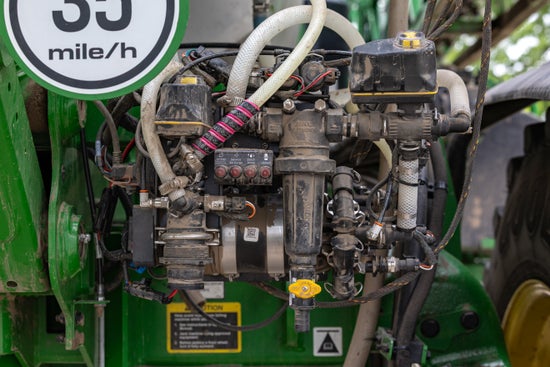
Thanks to advancements in spraying technology like SymphonyVision from Precision Planting, the options for chemical application go far beyond broadcast spraying.
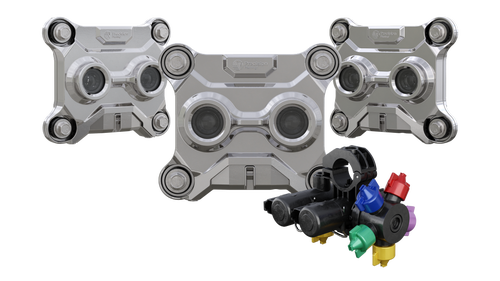
SymphonyVision uses intelligent cameras to distinguish crops from weeds and apply treatments accordingly. With SymphonyVision | Rate, the system automatically varies the rate of application based on weed severity with the nozzles remaining on at all times while SymphonyVision | Spot enables nozzles to shut off when weeds are not present, further maximizing herbicide savings.
With both Rate and Spot, you can optimize chemical applications without sacrificing weed control – a win for your bottom line and the environment.
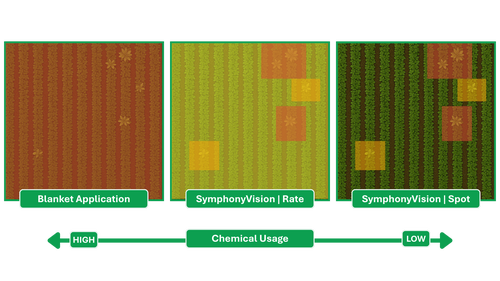
With SymphonyVision, you no longer have to apply the high label rate when only a small percentage of the field needs it. As the operator, you can define the rate applied for no/low weed severity (yellow), medium weed severity (orange) and high weed severity (red), giving you more control of your chemical weed control program than ever before.
What About Residuals?
There is one common question operators have when it comes to SymphonyVision and other spot-spraying technologies – what about residuals?
In efforts to fully understand the impact of residuals in a chemical program, Precision Planting’s research and development team executed a series of field trials. Let’s take a look at the results.
Corn Plot With and Without Residuals
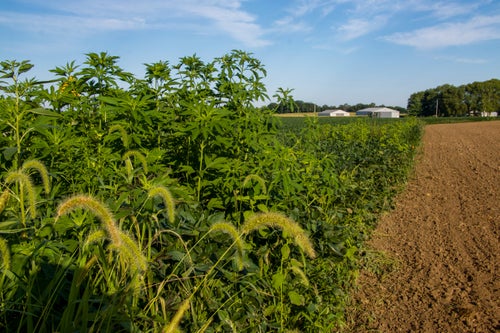
The images below were taken in a corn plot while scouting before the first post-pass. The crop on the left, Plot A, received 2.5 oz/A of Zidua residual in the pre-pass while the crop on the right, Plot B, received no residual.
While waterhemp was present in both areas, Plot B presented significantly more waterhemp as a result of no residual application in the pre-pass. Not only was the population within Plot B denser, but the weeds were also larger and healthier.
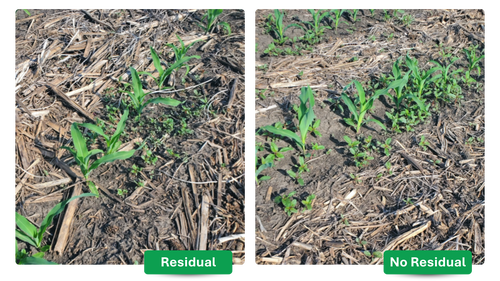
In Plot A, 2.5 oz/A of residual was enough to make a notable impact on weed prevalence and the density of those weeds. Plot B would ultimately require a quicker return to the field for the first post pass to ensure the waterhemp issues were addressed in a timely manner.
Soybean Plot With and Without Residuals
The field had 5 oz/A of Zidua applied at planting on most of the plot. However, no residual was applied on four 30-foot-wide treatments.
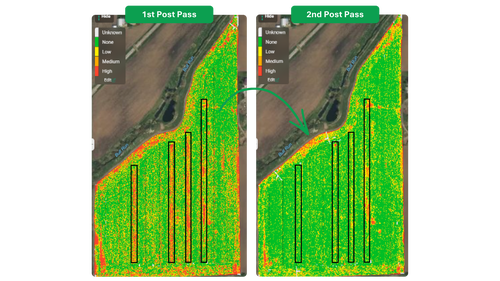
When looking at the weed severity map from the SymphonyVision cameras created during the first post pass, those four 30-foot treatments are easy to identify. Weed severity was significantly higher in the plot zones that did not receive the residual compared to the zones that did.
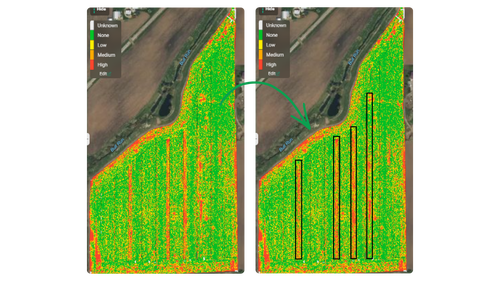
SymphonyVision cameras caught the four 30-foot treatments that did not receive residuals at planting, shown in red for the highest weed severity.
Maps from the second post pass revealed that the impacts of the residual applied at planting were still prevalent. The rest of the plot largely showed little to no weed pressure while the four 30-foot treatments revealed varying degrees of weed severity.
Let’s take the data from these maps and compile it into graphical form to get a better understanding of the impacts of residuals on weed severity. On the below graph, the height of each bar corresponds to the percentage of the field experiencing weed pressure with red, orange and yellow representing high, medium and low weed severity respectively.
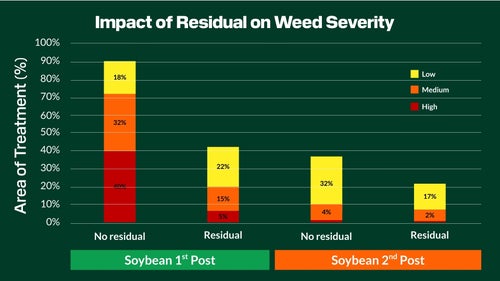
For the first post pass, total weed pressure across the acreage with residual was cut in half when compared to the acreage that didn’t receive residual. Most notably, 40% of the acreage was treated for high weed severity on the areas with no residual while only 5% for the areas that did receive residuals.
The Role of Residuals
The data shows that residual application helps reduce weed severity for subsequent passes which ultimately makes it easier to achieve the complete kill that you’re after as a few small weeds will be easier to control than a dense population of large weeds. With only a few small weeds throughout the field, you may buy a little extra time between passes thanks to residuals.
Weeds also develop less herbicide resistance when faced with residuals. If you can prevent weeds from ever emerging, there is less likelihood for contact herbicides to select for a resistant phenotype.
While it is evident that residuals provide an advantage regarding effective weed control, there is an increased expense when adding residuals to multiple spray passes throughout the growing season. For many growers, it may not make sense economically to add residuals to each pass unless there is a specific issue to address in terms of weed pressure – making SymphonyVision | Spot an ideal addition to their sprayer. But what about those who leverage residuals or other broadcast applied chemicals in every pass?
The Duo Difference
SymphonyVision | Duo combines the best of both worlds when it comes to chemical application. Duo enables you to broadcast apply one product mix while spot spraying a second product mix in the same pass. Experience the contact savings of SymphonyVision | Spot while still applying residual, fungicide or fertilizer to the entire field.
How It Works
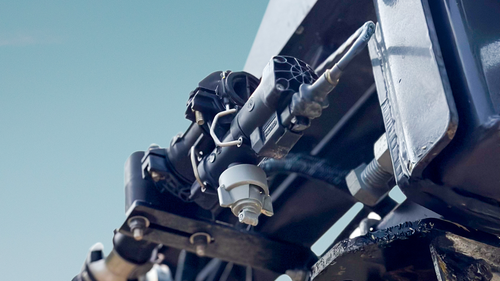
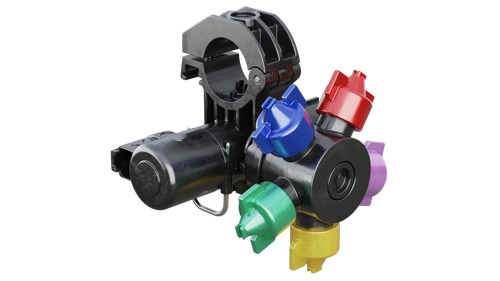
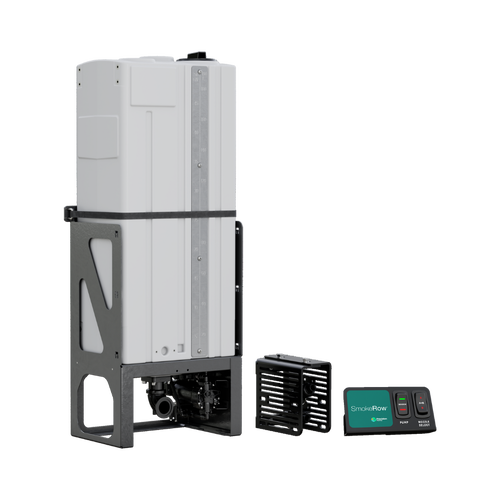
Duo leverages the SymphonyVision | Spot infrastructure with the addition of a secondary boom with SymphonyNozzles, an injection pump, mixer and concentrate tanks. The bulk tank hauls the chemical mix for broadcast application, while the concentrate tanks haul the contact herbicides. As the sprayer travels across the field, the injection system pulls liquid from the bulk tank, mixes it with the contact chemical, and sends it to the secondary wet boom.
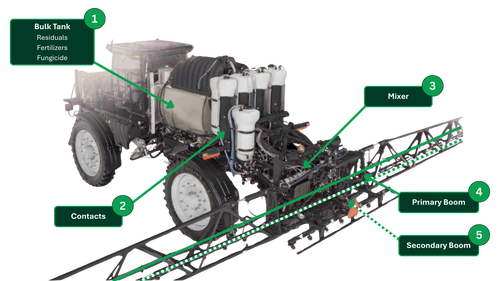
When no weeds are detected, the primary boom applies the bulk tank mix while the secondary boom remains off. Once weeds are detected, nozzle-by-nozzle the primary boom shuts off and the secondary boom nozzles turn on to apply the residual and contact mix only to the areas of the field that need it.
Learn more about how you can get the best of both worlds and utilize spot-spray technology on every pass with SymphonyVision | Duo.