Key Points
- Objective: To evaluate the yield and economic benefits of a cover crop system in a continuous rotation.
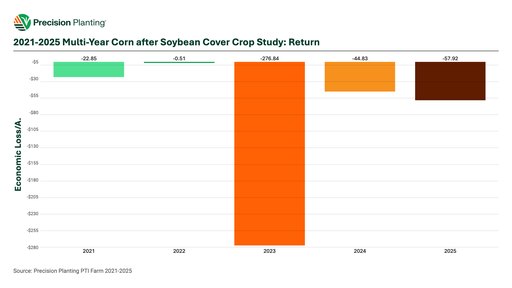
- Corn Results: Continuous corn planted over the last five years shows yield losses of -6.3 Bu/A compared to a non-cover crop system. The corn after soybean rotation varied greatly, with losses ranging from -$0.51 to -$276.84/A.
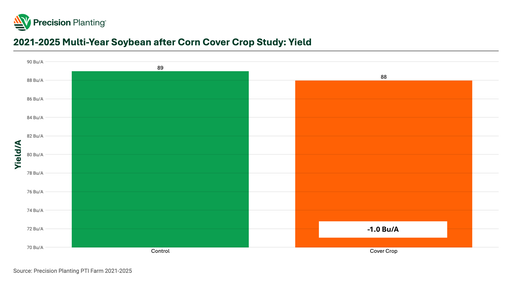
- Soybean Results: While soybean after corn 2025 results proved a +4.6 Bu/A increase, multi-year data shows a -1.0 Bu/A loss.
- Potential Benefits: Cover crops have the potential to prevent soil and wind erosion, improve soil health, suppress weeds, improve the availability of water, and even help break pest cycles. We continue to look for soil improvements as this study progresses.
At the PTI Farm, we’re halfway through a 10-year study to evaluate the impact of cover crops on our yield and economic performance. Cover crops have the potential to prevent soil and wind erosion, improve soil health and nutrition, suppress weeds, improve the availability of water and even help break pest cycles.
With all the potential benefits, we wanted to find out if it was true and how long it would take to make a difference.
We surveyed 1,000 midwest growers to see if they utilize cover crops. Half of them said yes! However, only a third felt like they were successful; another third said they were unsuccessful, while the final third wasn’t sure.
At the PTI Farm, fall strip-till was used as the primary tillage system. In the spring, the crop was planted directly on the fall strips into the green cover crop. Termination of the cover crop was implemented at 6" in height for continuous corn and corn after soybean trials, and 20" for soybean after corn trials.
We’ll need to continue testing to determine the long-term results, the difference in soil health, and if the cost of cover crops is ultimately worth it. Cover crops have the potential to offer big improvements across our fields, but it might come with some challenges too. Only time will tell!
Continuous Corn Cover Crop Results
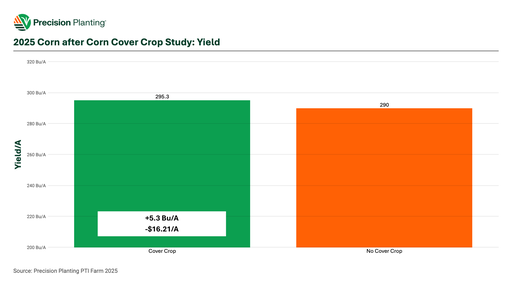
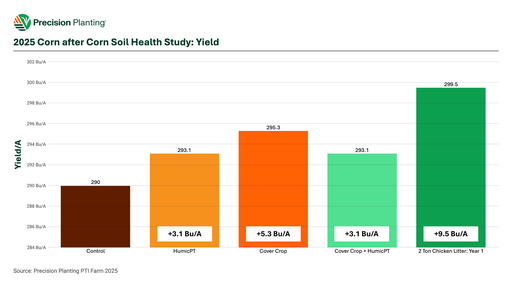
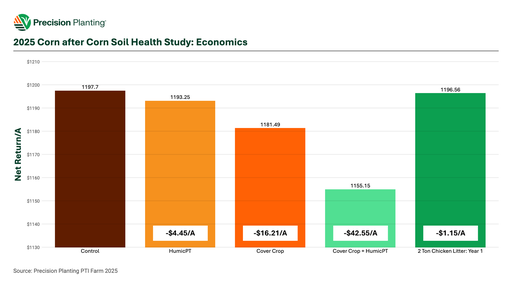
2025 data proved +5.3 Bu/A yield gains compared to a non-cover crop system. These gains resulted in an economic loss of -$16.21/A after the price of the seed and application cost. Multi-year data shows a -6.3 Bu/A yield deficit with economic losses of -$68.71/A.
Corn after Soybean Cover Crop Results
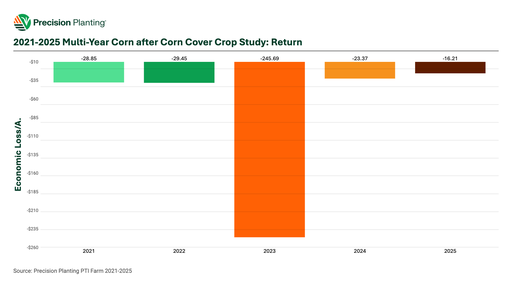
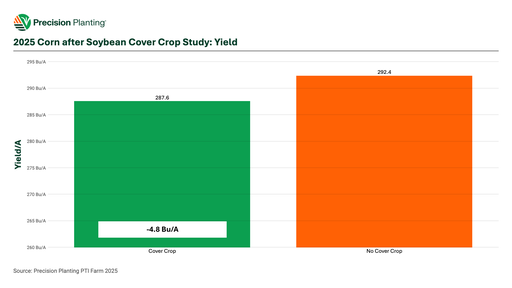
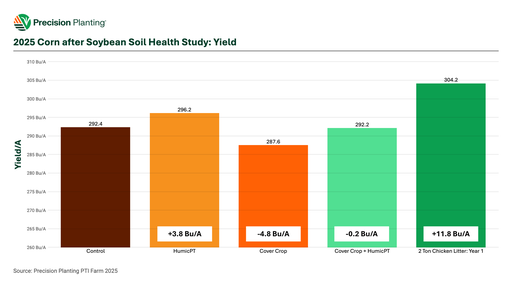
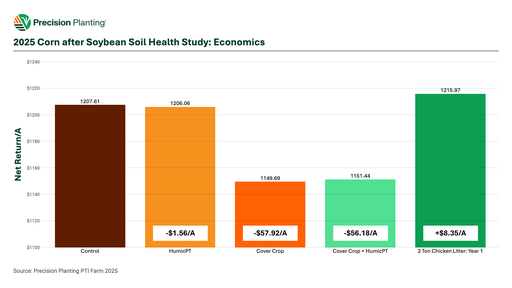
2025 data proved yield losses of -4.8 Bu/A. Multi-year data from 2021-2025 also reveals net economic losses annually ranging from as minimal as -$0.51/A to as high as -$276.84/A. Over the 5-year time span, cover crops have averaged losses of -$80.59/A.
Soybean after Corn Cover Crop Results
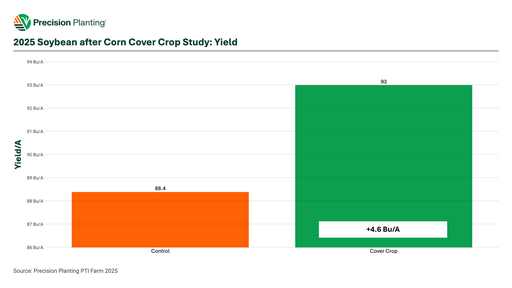
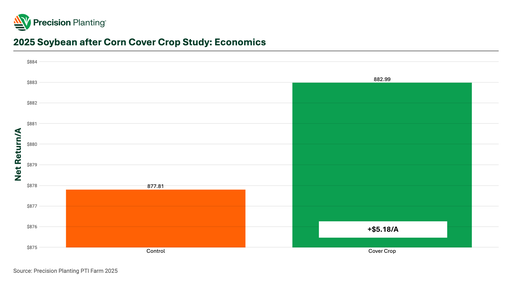
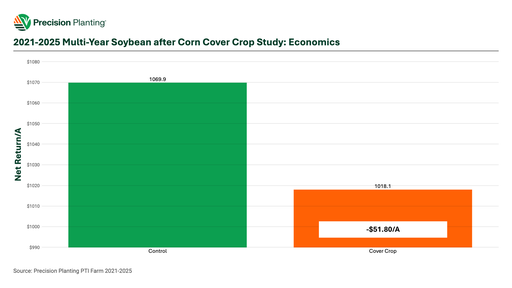
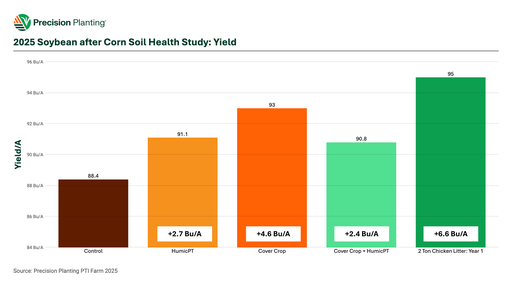
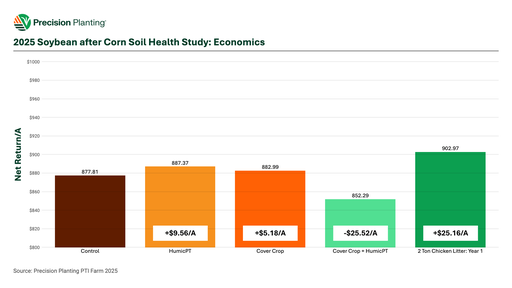
The soybeans in cover crop system proved +4.6 Bu/A yield gains over the non-cover crop control, with an economic gain of +$5.18/A. This is the first time cover crops have proved economic gains in the five years of this study. Multi-year data over 2021-2025, however, shows yield losses of -1.0 Bu/A and economic losses of -$51.80/A.
It is important to note that no program or subsidy cost reimbursements are calculated in this study, and could help offset losses.
Soil Health Study Results
Since the inception of cover crops at PTI, it has been difficult to show yield and profitability advantages. This study is designed to evaluate other practices that could increase soil health while establishing faster yield and profitability improvements. The following products have been added as soil health products as a part of this 10-yr cover crop study:
- HumicPT™, a soil conditioner applied at-plant via dual band Conceal, is designed to aid in the breakdown of organic matter. It can improve moisture management in the soil. This product contains Monty’s activated humics, which are processed using their proprietary technology.
- Chicken litter was also added as a soil health treatment. Nutrient rich chicken litter was applied at 2 ton/A before strip-tilling. Chicken litter is an excellent natural fertilizer source with vital nutrients (N, P, K micronutrients), and organic matter to improve structure, water retention and microbial life.
Cover Crop Summary
We look forward to continuing testing the use of cover crops to evaluate yield and economics of the system, while taking a close look at what cover crops can offer regarding soil health improvement. Being in our fifth year, we are hopeful yield, cash flow and soil health will improve soon. While the PTI Farm has lower soil erosion concerns due to smaller degrees of slope, we are trying to understand other advantages that a cover crop system could add to favor farm sustainability.
In-Depth Study Videos
InsidePTI S4•E01
Cover Crops ‣ Corn + Soybean
InsidePTI S3•E08
Cover Crops ‣ Corn + Soybean
InsidePTI S2•E31
Cover Crops
Study Details
Study data collected 2021-2025 at the PTI Farm in Pontiac, IL.
| Planting Date | Varied By Year | Hybrid | Varied |
| Row Width | 30" | Population | Corn - 36K Soybean - 130K |
| Corn Prices | 2025 - $4.13 2024 - $4.08 2023 - $5.31 2022 - $6.00 2021 - $5.00 | Soybean Prices | 2025 - $9.93 2024 - $11.46 2023 - $13.09 2022 - $13.96 2021 - $11.98 |