Key Points
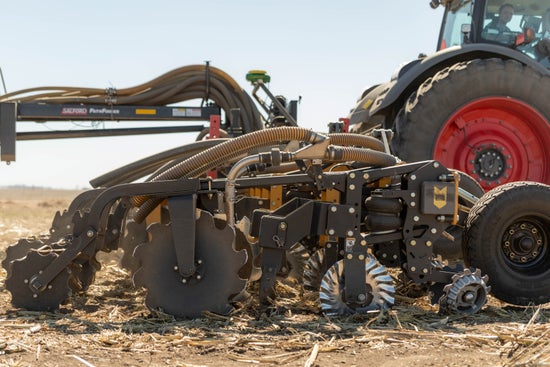
- Objective: To evaluate the yield and economic impacts of various tillage programs in a soybean after corn rotation, including conventional till, strip-till, vertical till, and no-till. We also evaluate the yield and economic benefit of implementing vertical tillage in corn stalks before a fall strip-till application to aid stalk decomposition.
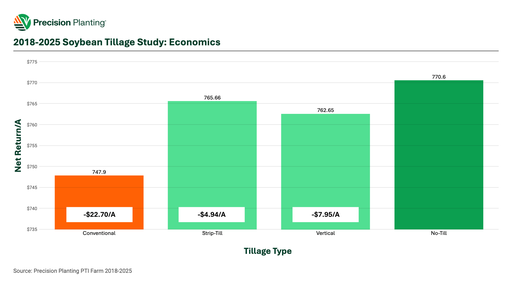
- Economic Gains: PTI data over the last eight years shows that no-till provides the highest economic gains, with a +$22.70/A gain over conventional tillage.
- Results: To understand both yield and economics, the University of Illinois Machinery Cost Estimate Summary is used to calculate individual cost of each tillage program. In 2025, for the three reduced tillage programs, an extra $10/A burn-down is also included due to higher herbicide costs that year.
Which tillage program is best for soybeans in a soybean after corn rotation?
Tillage and crop rotations can have a significant impact on soil preparation ahead of planting and yield increases as the soil improves in health. When we get this right, it can lead to some significant increases in yield. If we get it wrong, it can lead to air pockets, slowing us down in the field and even decreasing yield.
We’ve had great success with several of our tillage programs at the PTI Farm. In this study, we evaluated the yield and economic impact of various tillage programs, including conventional till, strip-till, vertical till and no-till.
Soybean Tillage Study Results
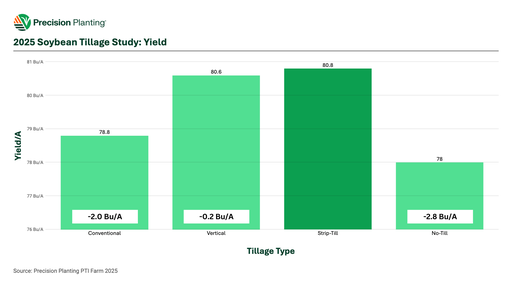
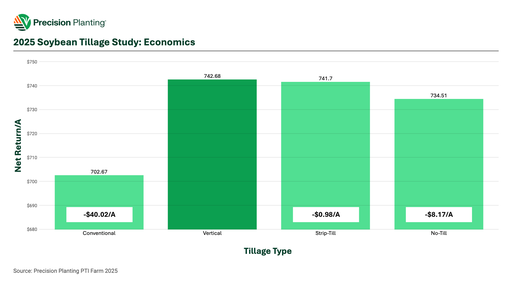
In 2025, yields varied only 2.8 Bu/A between all tillage programs, with strip-till offering the highest yield of 80.8 Bu/A. Where these methods separate more drastically is the economics. Across all eight years of the study, and considering the University of Illinois Machinery Cost Estimates, vertical till offered the highest overall revenue in our 2025 tillage system study. Compared to vertical till, no-till offered losses of -$8.17/A, strip-till -$0.98/A and conventional tillage with the highest losses of -$40.02/A.
Multi-year data from the PTI Farm over the time period of 2018-2025 shows that no-till has provided economic gains of +$4.94/A over strip-till, +$7.95/A over vertical till and +$22.70/A over conventional tillage.
Tillage Practice | Category | Cost |
| Conventional Till | Ripper | $40.40 |
| Soil Finisher | $15.30 | |
| Plant | $24.40 | |
| Total: | $80.10 | |
| Strip-Till | Strip | $26.10 |
| Burndown | $10.00 | |
| Plant | $24.40 | |
| Total: | $60.50 | |
| Vertical Till | Vertical | $18.50 |
| Burndown | $10.00 | |
| Plant | $29.60 | |
| Total: | $58.10 | |
| No-Till | Plant | $29.60 |
| Burndown | $10.00 | |
| Total: | $39.60 | |
| In-Line Ripper | V-Ripper | $29.90 |
| Soil Finisher | $15.30 | |
| Plant | $24.40 | |
| Total: | $69.60 |
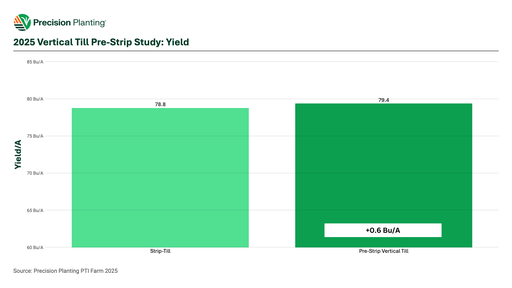
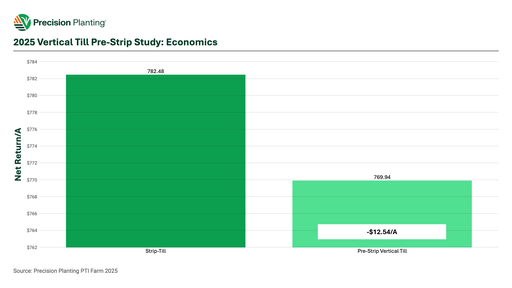
Separately, we evaluated the yield and economic benefit of implementing a vertical tillage pass in corn stalks before a fall strip-till application to aid stalk decomposition.
Vertical tillage pre-strip-till proved to be beneficial with a +0.6 Bu/A yield contribution. As a result of the extra pass, though, net economic losses occurred of -$12.54/A.
Related Study Videos
InsidePTI S3•E17
Tillage Programs ‣ Corn + Soybean
InsidePTI S2•E38
Strip-Till: Fall vs. Spring ‣ Soybean
Study Details
Study data collected 2018-2025 at the PTI Farm in Pontiac, IL.
| Planting Date | 2025 - May 5th 2024 - May 5th 2023 - May 5th 2020-2022 - May 17th 2018-2019 - May 10th | Rotation | BAC |
| Row Width | 30" | Population | 130K, 140K (2018-2020) |
| Soybean Prices | 2025 - $9.93 2024 - $11.46 2023 - $13.09 2022 - $13.96 2021 - $11.98 2020 - $9.75 2019 - $8.68 2018 - $8.80 | Hybrid | 2025 - Asgrow 27XF3 2024 - Asgrow 27XF3 2023 - Asgrow 27XF1 2022 - Asgrow 27XF1 2021 - GH 3582E3 2020 - Pioneer 31A22X 2019 - Pioneer 31A22X 2018 - Pioneer 31A22X |